Sustainable shipping is no longer a niche “nice to have” or an add‑on benefit for select customers—it’s now an expectation. As companies face stricter regulatory guidelines and growing consumer pressure, demonstrating measurable progress on sustainability commitments has become more important than ever.
Why Sustainable Shipping Is So Important
Today’s eco-conscious consumers are actively seeking brands that take efforts to reduce waste and emissions. With rising demand for green packaging, carbon‑conscious logistics, and ethical, transparent supply chains, many forward‑thinking brands are taking steps toward more sustainable operations.
According to a 2025 study from Shorr Packaging, a national packaging distributor, 90% of respondents said they are more likely to purchase from a brand or retailer if its packaging is eco-friendly, 87% of consumers said they’d happily buy more sustainable products if they were easier to find, and 54% reported consciously purchasing products with sustainable packaging in the last six months.[1]
In another study, more than one-third of consumers—and over 55% of those aged 18 to 34—said they are even willing to pay an additional one or two dollars for more sustainable shipping.[5]
It’s not just consumers who are demanding more environmentally friendly operations—stakeholders, too, are pushing for higher transparency in order to meet stricter regulatory requirements and maximize value. In one 2024 Deloitte study, 83% of surveyed investors reported incorporating sustainability information into fundamental analyses, and 79% stated that they have sustainability policies in place, compared to just 20% five years prior.[6]
While stakeholders and consumers alike appear ready for the shift to more eco-friendly operations, meeting these expectations can present shippers with significant challenges.
Key Challenges in Creating Eco‑Friendly Operations
To meet the demand for more eco-friendly initiatives, businesses are under pressure to explore new options for reducing waste and streamlining supply chains.
Some of the most pressing challenges for today’s shippers include:
-

Balancing sustainability goals with cost efficiency
Although sustainability initiatives often deliver long-term cost savings and optimized efficiencies, they also typically come with upfront costs—whether investing in eco‑friendly packaging options or electric delivery vehicles.
For many shippers, the challenge lies in finding ways to invest in a more eco-friendly future without passing on costs to customers.
-

Dealing with delivery route inefficiencies
Whether caused by inadequate route planning or a failure to fill trucks to capacity, inefficient routing can lead to high fuel costs, inefficient labor resourcing and unreliable delivery standards. Optimizing routes has now become essential not only for meeting sustainability goals but also for lowering costs.
-

Managing packaging waste
Unrecyclable boxes, extraneous fillers, oversized packages and more can all contribute to a company’s environmental footprint.
As brands seek to reduce packaging waste, they may face varied challenges—from streamlining operations in the face of unpredictable order volume to ensuring deliveries are still well-protected enough to prevent damage in transit.
And with many consumers having grown accustomed to a certain level of packaging with their orders—particularly for higher‑end purchases—communicating the shift and gaining support for more minimal, eco‑friendly options can pose a challenge in itself.
-

Demonstrating impact and value
Although demand for more sustainable operations is growing, trepidation around upfront costs, inconsistent regulations across different divisions or locations, and general wariness around shifting culture can all present obstacles for shippers aiming to make strides toward sustainability.
Even after initiatives are in place, logistics teams may struggle with clearly demonstrating the impact and value of the changes in order to get buy‑in from the C‑suite.
Despite these challenges, many brands are taking steps toward more sustainable operations.
The United States Postal Service’s Commitments to Sustainability
The United States Postal Service (USPS) has taken its own steps toward greener supply chain and logistics operations:
- Since the initiation of modernization efforts in 2021, USPS has made the shift from air networks to more efficient surface routes. This led to a 21.6% reduction of Scope 3 greenhouse gas (GHG) emissions from contract transportation in 2024 compared to the previous year.[7]
- USPS set a FY30 target to increase its packaging recycled content to 74%, as well as a goal to increase its package recyclability to 88%.[8]
- Offering a range of recyclable and flat‑rate shipping options,[9] USPS makes it easier for shippers to reduce waste and simplify logistics. Meeting Sustainable Forestry Initiative or Forest Stewardship Council certification standards, all Priority Mail® and Priority Mail Express® paper and cardboard packaging are made from recycled content and are recyclable themselves.[10]
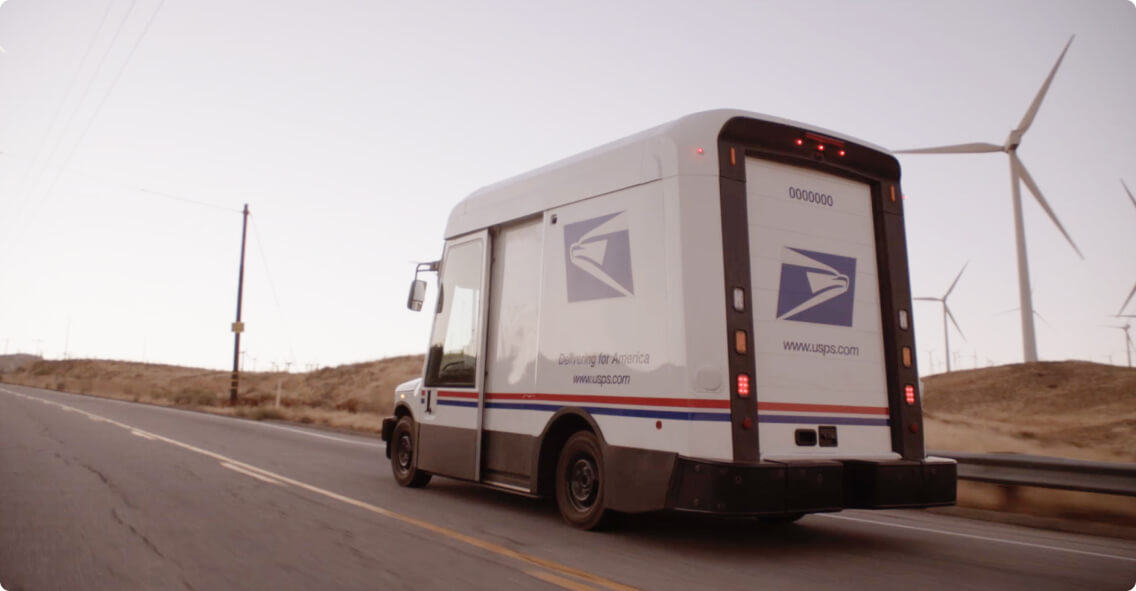
- USPS is deploying battery electric vehicles (BEVs) throughout the U.S., which includes Next Generation Delivery Vehicles (NGDVs)—designed specifically for mail and package delivery—as well as new commercial-off-the-shelf (COTS) vehicles.[11] These are designed to enhance safety for employees while improving service for customers.[12]
- USPS is replacing inefficient lighting at company facilities with LED/high-performance solutions while also modernizing building control systems to reduce energy consumption and improve performance.[13]
- Maintaining more than 31,000 retail locations,[14] USPS helps support local, low-mileage drop-offs for customers across the U.S.
USPS BlueEarth®
The free USPS BlueEarth® Carbon Accounting Service makes it simple for businesses to measure and manage their supply chain carbon emissions, with detailed online reports on GHG emissions.
How to Get Started With an Eco‑Friendly Supply Chain
As Earth Month kicks off in April, shipping and logistics professionals have an ideal opportunity to get started on sustainability initiatives for the month ahead and beyond. Focusing on the following steps can make it easy to get started:
Checklist for shippers
-
Use recyclable, recycled or bio‑based packaging
From packages made of organic, bio‑based materials such as cornstarch and agricultural byproducts to bioplastic packaging produced from sawdust or other renewable resources, today’s shippers have an array of options at their disposal.
-
Ship smarter with flat-rate boxes
All flat‑rate Priority Mail® and Priority Mail Express® paper and cardboard packaging is made from recycled content and is recyclable. Using flat‑rate boxes also saves money, as shippers pay a fixed price regardless of what is shipped, as long as it weighs less than 70 lbs.
-
Encourage customers to consolidate shipments
Reduce delivery trips and fuel emissions by offering customers an incentive—such as a lower shipping rate or a “freebie”—for consolidated shipments. Presenting a clearly labeled “green” option at checkout can also inspire customers to make more eco‑friendly choices.
-
Highlight your sustainability efforts
Put a spotlight on your company’s commitments to sustainability initiatives—including your partnership with USPS, which maintains its own sustainability commitments—in client‑facing communications. This helps give customers a tangible reason to choose your brand.
Checklist for logistics companies
-
Optimize delivery routes
Leverage the USPS route‑optimized nationwide network, which reduces superfluous trips and strives to fill trucks to capacity. Route optimization software can also be used to identify the most efficient paths, reducing both emissions and fuel use. Similarly, optimizing vehicle capacity ensures delivery trucks are fully loaded while meeting specific cargo requirements, significantly cutting the number of vehicles on the road.
-
Invest in electric or low-emission vehicles
While electric or hybrid delivery trucks can come with upfront costs, they can bring about significant savings, increased efficiencies, and reduced emissions and fuel use.
-
Work with eco-conscious partners
Choosing vendors and suppliers that show a clear commitment to transparent, environmentally friendly operations can make it easier to meet sustainability goals.
-
Set key performance indicators (KPIs)
Defining clear KPIs and implementing robust data collection processes will make it easier to present tangible gains to the C‑suite while focusing on the issues that matter most to stakeholders, consumers and the broader community.
Key Takeaway
Sustainability has become much more than a trend—it’s now both a business and consumer imperative. Taking steps to create greener operations—from working with recycled packaging materials to optimizing the supply chain—not only creates a more eco‑friendly supply chain but also brings about speedier, streamlined and more cost‑efficient operations.
Leveraging USPS shipping options can help brands achieve their sustainability goals. With a tangible commitment to environmentally friendly operations and an array of options for companies of all sizes, USPS makes it easier to meet consumer demand for sustainable shipping.
Footnotes
keyboard_arrow_down- [1]“The 2025 Sustainable Packaging Consumer Report,” Shorr, Jan. 30, 2025. arrow_right_alt
- [2]Ibid. arrow_right_alt
- [3]Ibid. arrow_right_alt
- [4]Ibid. arrow_right_alt
- [5]Excerpted from “What do US consumers want from e-commerce deliveries?”, February 2025, McKinsey & Company, www.mckinsey.com. Copyright © 2025 McKinsey & Company. All rights reserved. Reprinted by permission. arrow_right_alt
- [6]Michael Bondar, Jennifer Steinmann, Krissy Davis, Kristen Sullivan, Bhaskar Chakravorti, DP Singh and Patrick Schena, “How can the enterprise earn investor trust through sustainability disclosures?” Deloitte, March 12, 2024. arrow_right_alt
- [7]“2024 Impact Report,” United States Postal Service, August 2025. arrow_right_alt
- [8]Ibid. arrow_right_alt
- [9]“Sustainable Products for a Greener Tomorrow,” The Postal Store®, United States Postal Service. arrow_right_alt
- [10]Ibid. arrow_right_alt
- [11]“2024 Impact Report,” United States Postal Service, August 2025. arrow_right_alt
- [12]Ibid. arrow_right_alt
- [13]Ibid. arrow_right_alt
- [14]“31,063 Post Offices,” Postal Facts, United States Postal Service. arrow_right_alt